
Dam Safety & Planning
← Back to all guidesHow to Read Dam Water Release Charts (Step‑by‑Step Guide)
Published on: March 15, 2024 · Approx. 8 minute read
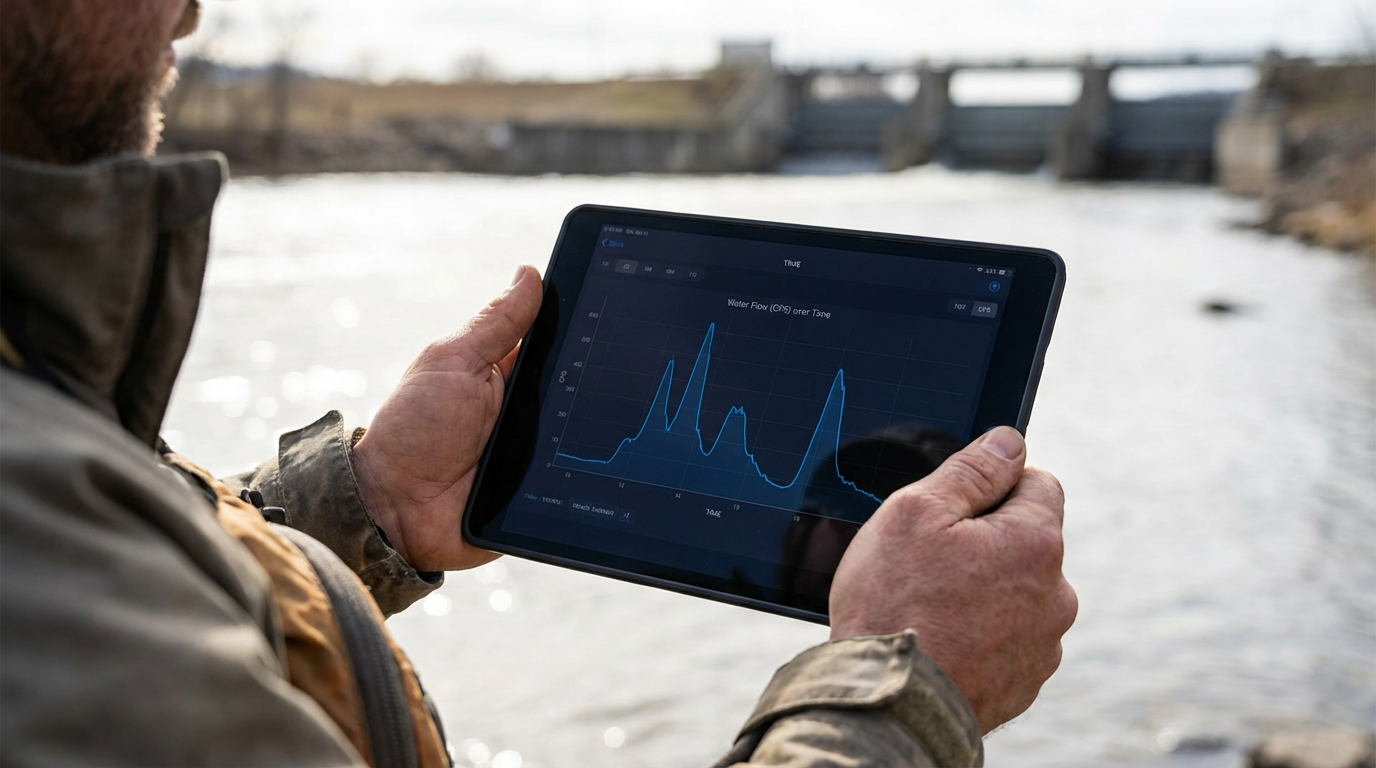
If you fish below dams, learning to read water release charts is one of the highest ROI skills you can develop. It helps you avoid dangerous conditions, predict when fish will feed aggressively, and plan trips around the exact flows that work best on your home water.
In this guide we'll walk through real‑world concepts—not engineering jargon—so you can confidently glance at a chart on your phone and instantly answer two questions:
- Is it safe to fish this dam right now?
- Are the flows in a good range for the species and style of fishing I have in mind?
Key Terms You'll See on Dam Release Charts
Every agency formats charts a bit differently, but the same core ideas show up almost everywhere:
- CFS (Cubic Feet per Second) – how much water is moving past a certain point every second. Higher CFS = faster, deeper, more powerful water.
- Stage / Gauge Height – the water level at the gauge, usually in feet. This can react slower than CFS, but it's useful for visualizing how “high” or “low” the river is.
- Generation / Turbine Units – how many turbines are running at a hydroelectric dam. “0 units” usually means low, stable flow. “2 units” might mean water jumps from wadeable to dangerous in minutes.
- Planned vs. Actual Releases – schedules are forecasts; real‑time charts show what's actually happening right now.
The Catch Dam Fish dashboard pulls this information together for you so you don't have to bounce between multiple confusing agency pages.
Step 1: Check the Recent Pattern, Not Just the Latest Point
A common mistake is to look only at the latest CFS number without context. Instead, zoom the chart out to at least the past 12–24 hours and ask:
- Has the dam been stable, with flat lines?
- Are there sharp spikes where power generation kicked on?
- Is today following a repeatable pattern from the last few days?
Stable flows are ideal for most fishing situations. Rapid rises often mean dangerous conditions, debris, and disoriented fish—even if the current CFS number doesn't look terrifying on paper.
Step 2: Learn the "Safe Range" for Your Spot
Every tailwater has a CFS or stage range that locals consider “safe enough” for wading or bank fishing. You can learn this range in three ways:
- Ask local anglers or bait shops what CFS they prefer.
- Log your own trips—after every outing, record the flows in your dashboard or notes app.
- Compare photos to charts: look up the flows from days when you took bank or wading pictures.
Over time, you'll end up with mental anchors like “Under 2,000 CFS is comfortable with a wading staff; over 3,000 I stay on the bank; over 5,000 I don't go.”
Step 3: Watch for Sudden Rises and Multiple Unit Starts
Even if the current flow looks okay, a scheduled release can change things fast. When reading charts and schedules, look specifically for:
- Start times for each unit – on many dams, one unit might be manageable but a second unit makes the river unfishable.
- How fast the water rises – some tailwaters jump thousands of CFS in 15–30 minutes.
- Weekend vs. weekday patterns – power demand often changes release habits on weekends and holidays.
The safest habit is to assume water will rise sooner and faster than the schedule suggests—and to always have an exit route picked out before you step in.
Step 4: Combine Flows with Weather and Season
Flows don't exist in a vacuum. Fish behavior also depends on water temperature, clarity, and season. For example:
- Spring: rising flows plus slightly stained water can trigger aggressive feeding.
- Summer: cold releases from the bottom of a reservoir can keep tailwaters fishable when everything else is too warm.
- Winter: stable, low flows are usually better than big swings.
Our weather and conditions tools help you see all of this in one place so you can decide whether it's a day for power fishing reaction baits or slowing down with finesse presentations.
Step 5: Build a Personal "Green / Yellow / Red" System
To simplify decisions, many experienced anglers create a simple traffic light system tied to CFS or stage:
- Green – safe and comfortable to wade or bank fish; ideal for learning new water.
- Yellow – fishable with caution and experience; stick to familiar spots and stay close to exit routes.
- Red – unsafe or not worth the risk; fish a lake, pond, or different section of river instead.
Inside Catch Dam Fish we're focused on helping you turn raw numbers into clear decisions like this so you can spend less time decoding charts and more time actually fishing.
Putting It All Together Before Your Next Trip
Before you head to the dam, quickly run through this checklist:
- Check the last 12–24 hours of flows.
- Compare the current number to your safe range.
- Look for planned unit starts or sudden spikes.
- Factor in season, water temperature, and weather trends.
- Decide: Is this a green, yellow, or red day?
If you're ready to make this process even easier, create a free account and start tracking your favorite dams in one place: